Web Design Agency for AI Search: What They Should Actually Build (and How to Choose One)
A web design agency or studio that builds for AI search should do more than produce an attractive website in this coming age and add a few SEO settings and call it a day. It should make the business’s most important information accessible, understandable, discoverable and easy to verify whether someone finds it through Google, Bing, ChatGPT or another search experience.
On this page
This involves good website development, technical SEO, accurate business information and increased consideration for AI agents that may navigate websites on behalf of customers in the future.
But there is a distinction worth making early: a website can be technically ready for AI search without ever being recommended by an AI assistant, always know that.
Readiness is something a developer can test while recommendations are decisions made by search systems that the developer doesn’t control.
So when choosing a company, understanding that difference could save you from paying for promises nobody can reliably deliver.
What does a web design agency that builds for AI search actually do?
Ok; an AI search focused web design agency builds or improves websites so that relevant search systems can access their content, interpret business information correctly and potentially use that information when responding to customers.
Much of this underlying work is not new as a website still needs functioning pages, sensible navigation, useful content, technical accessibility and a reason for customers to trust the business.
What is changing is how people discover that information.
For example, someone looking for an industrial machinery supplier might have searched Google for “used CNC machinery UK” and opened several websites.
These days they might ask an AI assistant for a prompt like “Find companies that supply used CNC machinery, ship internationally and can help me compare suitable machines”.
That is a more demanding question than the first one and it involves products, geography, capabilities and commercial conditions.
So a website with little more than just a homepage and a contact form may not provide enough information to answer it well resulting in less inquiries.
But a more useful website would explain the machinery categories available, what inspection or support services the company provides, which markets it serves and how a buyer requests a quotation and much more.
Some of that information might also still be missing from the AI generated answer so other sources may be used and the assistant may choose different suppliers - can you see what outcome this will produce.
Nevertheless; the business has given people and machines a considerably better source to work with and that is the foundation of an AI search ready website.
Is AI-search web design different from traditional SEO?
There is considerable overlap here and some of the terminology makes it sound larger than they are.
Traditional search engine optimisation helps websites become discoverable and useful within search engines while Answer Engine Optimisation (AEO) and Generative Engine Optimisation (GEO) are commonly used to describe work intended to improve how information appears in AI generated answers and over views.
The labels are convenient but they are not three entirely separate technical systems.
Google makes this point in its official guidance on generative AI search: the fundamentals of SEO continue to apply to AI Overviews and AI Mode.
Consider the following.
| Area | What a competent agency should address |
|---|---|
| Traditional SEO | Crawling, indexing, relevant content, internal links, technical problems and search performance |
| AI search visibility | Whether information is accessible, accurate, useful and suitable for retrieval by relevant systems |
| AEO/GEO content work | Clear explanations, real evidence, direct answers and coverage of important customer questions |
| AI-agent readiness | Predictable navigation, accessible forms and supported ways to complete authorised tasks |
| Commercial performance | Whether visits and enquiries turn into meaningful business opportunities |
These activities overlap.
So a well built business service page might help a prospective customer qualify for ordinary search results and provide useful information to an AI assistant without requiring three different versions so be cautious when an agency proposes separate pages for every slight variation of an AI search question as it may create unnecessary content and maintenance work rather than provide value.
The question is not whether an agency calls its service SEO, AEO or GEO - It is what the agency can demonstrate it will improve when providing the service.
What makes a website genuinely ready for AI search?
Unfortunately there is not one official “AI ready website” standard accepted by every search provider as different systems retrieve different information and their crawling capabilities, ranking methods and sources can also change.
Still, there are several practical requirements worth investigating before commissioning a website.
1. Important content should be accessible without unnecessary technical barriers
Imagine a business website where the service descriptions appear only after a visitor’s browser runs several JavaScript files.
To a human using a modern browser the page may look completely normal but to a system retrieving the original HTML without executing the JavaScript, the same page might contain little useful text.
Note that does not mean JavaScript websites cannot rank.
Google can render JavaScript and has supported JavaScript heavy websites for years and its own JavaScript SEO documentation explains the process and some of its limitations.
While other crawlers and retrieval systems do not necessarily retrieve information in the same way.
So we recommend for important public pages, serving the main information in the initial HTML is therefore a sensible engineering choice as it reduces dependence on a particular crawler’s ability to execute scripts and reduces time to retrieve the information.
An expert agency should be able to show you the difference between the initial HTML and what appears after the page has finished loading.
So ask it to demonstrate a real service page not just its homepage as a page that looks impressive in a browser but delivers almost none of its important information until JavaScript runs deserves closer investigation.
2. Search crawlers must be permitted to access the right pages
Did you know that a website can unintentionally restrict access to systems its owner actually wants to reach.
The familiar robots.txt file is one part of this as it communicates crawling rules but it is not the only possible barrier as also a hosting provider, firewall or content delivery network can apply separate restrictions as well.
Cloudflare for example provides controls for different categories of AI crawler traffic and settings vary by configuration and can affect different types of bots differently.
OpenAI also distinguishes between several kinds of crawler.
- OAI-SearchBot supports surfacing websites in ChatGPT search features.
- GPTBot is associated with crawling content for model training.
- ChatGPT-User is associated with certain user triggered retrievals.
These serve different purposes and website owners can make different access decisions.
OpenAI’s crawler documentation explains the distinction.
For example blocking a training crawler is not necessarily the same decision as blocking a search crawler and not every business automatically allow unrestricted automated access as the appropriate policy depends on the website, its content, applicable agreements and the business objectives.
What matters most is that the agency understands these differences and checks that the actual server and security configuration match the agreed policy.
Note that a screenshot of robots.txt alone does not prove every relevant crawler can fetch the website.
3. Google and Bing should be part of the technical plan
One weakness in some AI search proposals is their narrow focus on ChatGPT, yet search and AI discovery involve several systems and the relationship between them is not identical.
For example, Google’s AI Overviews and AI mode needs a supporting page to be indexed and eligible to appear with a snippet in Google search. That is a documented requirement and not a special GEO trick.
Bing deserves attention as well as Microsoft introduced AI Performance reporting in Bing Webmaster Tools in February 2026, providing information about citations and grounding queries across supported AI experiences and further topic level reporting followed.
Therefore an agency should be able to explain how it will investigate indexing problems in both Google and Bing rather than assuming that success in one proves visibility everywhere.
We think a reasonable technical delivery plan should include checking important URLs, indexability, canonical tags, sitemaps, internal links and relevant search console reports.
None of these actions guarantees an AI citation by the way but they do however, address identifiable obstacles.
4. The website needs clear, verifiable business information
Let take an example for this - Suppose someone asks an assistant:
“Which IT support companies work with businesses in Manchester and provide managed cybersecurity services?”
A company’s homepage might say: “We deliver innovative solutions that empower your digital transformation”
That sounds polished but it answers very little.
A more useful description might say:
“We provide managed IT support, Microsoft 365 administration and cybersecurity services to businesses in Greater Manchester”
The second version identifies services, customers and geography and gives a prospective buyer something to evaluate.
This is where business information becomes more important than simply producing additional content.
Service areas change - Certifications expire - Product models are discontinued - Prices and availability may be updated.
And if a website contains conflicting information across several pages, an AI system may encounter the wrong version and also a customer might experience that too.
A responsible agency should establish which business facts are approved, where they are published and who will keep them current.
Note that is not normally described as web design. Increasingly it ought to be part of a serious digital infrastructure project.
5. Structured data can help describe content but it isn’t an AI recommendation switch
Structured data is information added to a page in a machine readable format often using Schema.org vocabulary.
It can help describe a business, an article, a product or another recognised entity.
Used correctly it may also support eligibility for certain Google Search features but what it cannot do is force ChatGPT to recommend a company or business.
Google explicitly states that no special Schema.org markup is required to appear in its generative AI features.
But there is a practical reason to keep structured data accurate: a website’s technical description should match what people can actually see.
An agency that offers to add dozens of schema types should explain why each one is appropriate.
For a local business accurate business details may be useful but for an online retailer supported product information and legitimate merchant feeds may matter more while an ordinary service website, making the offering understandable could produce more practical value than implementing elaborate markup that nobody maintains.
6. The website still has to work for customers
Search visibility is only useful if the website does something with the opportunity.
Imagine two machinery suppliers are mentioned in an AI generated answer with the first having a slow page, unreadable specifications on mobile and a contact form that doesn’t confirm whether a request was received.
The second supplier’s website has clear specifications, relevant photographs, delivery information and a quotation form that asks for the machine type, destination and intended application.
Both suppliers receive similar exposure but the buying experience is going to be different.
That doesn’t establish that the second website will always convert better as price, stock, reputation and many other factors come into play and affect purchasing decisions.
But it does show why website design cannot stop at discovery anymore.
A premium well designed, converting website should make it straightforward for a serious buyer to understand the offer and take the next step.
This means testing mobile usability, accessible navigation, forms, page performance and the entire enquiry journey plus understanding the business, its market and its buyers.
Speed is also important for user experience but there is no established universal rule that achieving a particular PageSpeed score causes ChatGPT to cite a website, yet slow server response times, heavy JavaScript or timeouts can still prevent AI bots from crawling and referencing your content in the first place.
Fast, reliable delivery especially accessible raw HTML ensures AI retrieval systems can fetch your page before hitting strict timeout limits but treat performance as a real engineering and customer experience requirement not an invented AI ranking formula.
What about websites designed for AI agents?
AI search and AI agents are related but they are not the same thing.
An AI search system might retrieve information and recommend a supplier.
While an AI agent may go further, like navigate a website, compare products, fill in an enquiry form or use an approved booking process on someone’s behalf.
And there are different levels of readiness.
AI-search-ready: Important information can be discovered, retrieved and understood by a relevant systems.
Agent-ready: The website has predictable navigation, understandable controls and processes that can support an authorised agent completing defined tasks.
Agent-transactable: The business provides explicitly supported ways for agents to perform particular transactions with appropriate authentication, consent and confirmation.
The distinction matters because not every website needs custom agent technology.
For example a small professional services company may simply need clear service descriptions and a dependable contact or booking form.
While an ecommerce business with thousands of products may have a stronger reason to investigate product feeds and supported commerce integrations and a B2B supplier handling high value quotations might eventually benefit from a secure interface that lets an authorised agent request information or submit a non-binding enquiry.
That does not mean it should allow an autonomous system to accept commercial terms without human approval.
Google’s agent-friendly website guidance discusses accessible labels, predictable interactions and stable page layouts.
Those are sensible improvements for people as well as agents.
Custom integrations should follow a demonstrated business requirement and they should not be added simply because an agency wants to sell an expensive new feature.
Do you need a new website to become AI-search-ready?
I am going to answer this with: depends..
A website may already have a sound foundation and be technically accessible, reasonably fast and indexed in search engines but lack detailed service information or accurate business facts, so replacing the whole website would not necessarily solve those problems any better than carefully improving the existing one.
Other websites may have deeper issues.
Perhaps the main content is difficult to retrieve, the navigation has grown confusing after years of changes and additions and the platform limiting technical control, important pages have duplicate URLs or the company cannot update information without introducing another problem.
In those situations, rebuilding becomes more reasonable.
The decision should come after an assessment.
| Situation | Sensible starting point |
|---|---|
| Technically sound website with thin service pages | Improve the content and information architecture |
| Search crawler or indexing problems | Investigate the configuration before considering a rebuild |
| Outdated business details across multiple pages | Establish and maintain an accurate source of information |
| Slow, fragile website with recurring maintenance problems | Compare repair costs with a rebuild |
| Difficult forms or a poor mobile buying journey | Improve the relevant customer workflows |
| Major business repositioning and an unsuitable existing architecture | Consider a strategic rebuild |
A good agency should be comfortable recommending less work when less work will solve the problem.
That is a useful test of its judgment.
Astro, WordPress, Webflow, Wix or Shopify: which platform is best for AI search?
There is no universal winner but we lean to Astro.
Platform choice matters but the way the website is implemented matters more than the logo on the technology stack.
An excellent WordPress website can be accessible, fast and well organised but a poorly implemented Astro website can still have broken links, weak content and indexing problems.
The same applies to hosted website builders.
| Platform | What to consider |
|---|---|
| Astro | Strong fit for content focused websites with static HTML generation and selective interactivity. More development responsibility may be appropriate for bespoke requirements. |
| WordPress | Flexible and widely supported. Performance, security and maintainability depend heavily on implementation, plugins and ongoing care. |
| Webflow | Useful visual development and CMS capabilities. Check content structure, technical control and integrations against the actual project. |
| Wix / Squarespace | Can work well for straightforward business websites. Evaluate the specific site’s indexing, accessibility, performance and future needs instead of assuming it is unsuitable. |
| Shopify | A practical choice for many ecommerce businesses with established product and commerce functionality. Theme quality, apps and product data accuracy still matter. |
| Custom JavaScript applications | Appropriate for some advanced products but public content and navigation need deliberate rendering and accessibility decisions. |
At Crawl Nine we specialise in Astro because its architecture suits the kind of fast, content rich and technically controlled websites we often want to build, plus we tested the performance time and time again.
That doesn’t make Astro the correct choice for every business, we do not recommend that just because we work with it.
For example a retailer with a complex Shopify operation should not be pushed onto a custom platform merely because the agency prefers building on it.
Likewise, a company with a well maintained WordPress site may benefit more from improvements than a complete migration.
So when comparing agencies always ask them to justify the recommended platform in terms of your business not their portfolio preferences and because they like using that platform.
How do you choose a web design agency for AI search?
The most useful way to evaluate an agency is to ask for evidence of its process.
A good proposal should explain what the agency will investigate, what it will build, how the result will be tested and who will be responsible for keeping it accurate.
By the way, you do not need to understand every technical detail.
But you do need to know what you are paying for.
Here are the questions we would bring into an agency meeting. Yes; and ours!
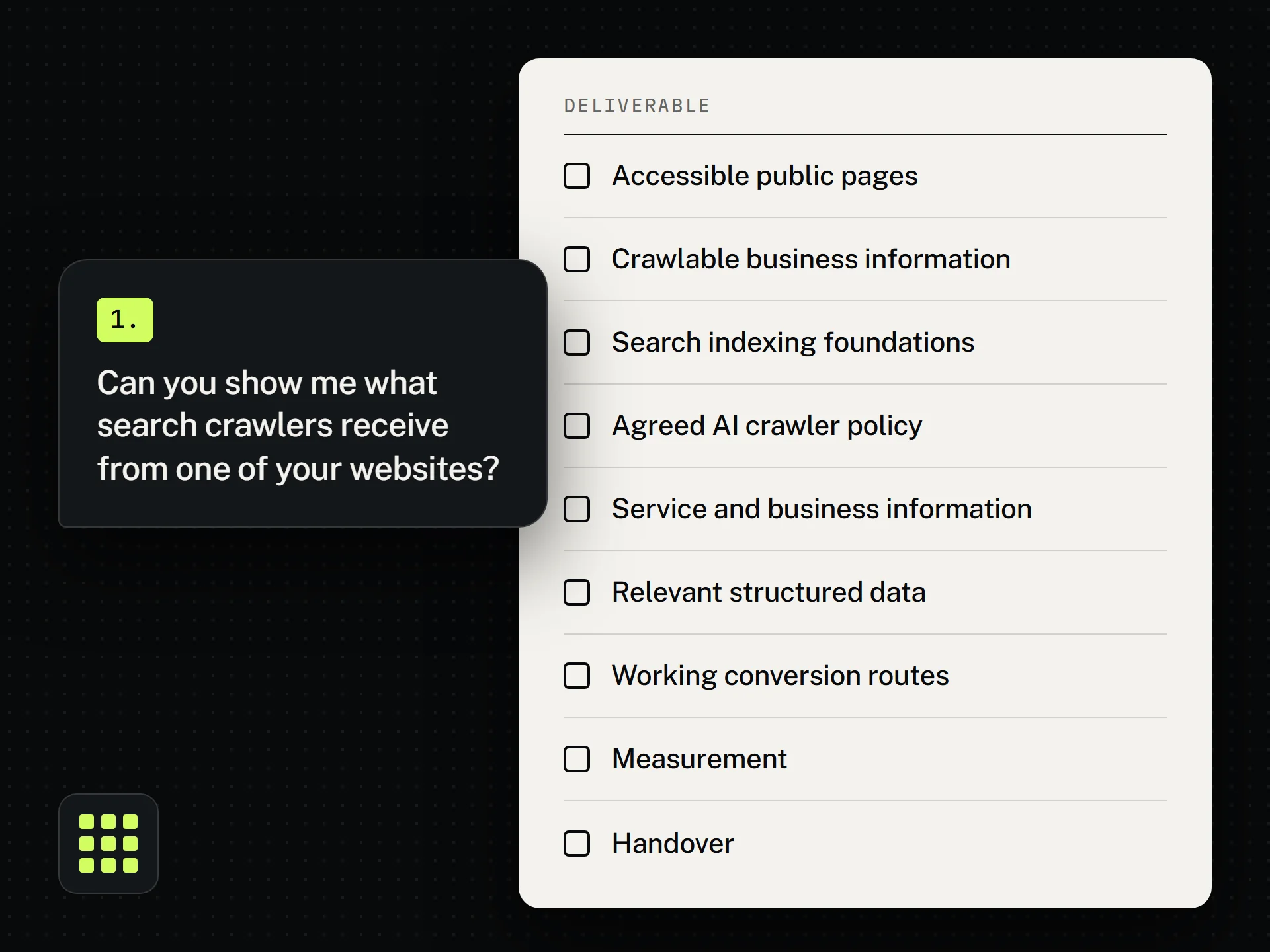
1. Can you show me what search crawlers receive from one of your websites?
Ask for an example of a completed project.
The company should be able to demonstrate what the server delivers, where important content appears and whether that content is accessible without relying entirely on client side JavaScript.
One screenshot is not a complete audit but an agency should understand the question and be prepared to investigate it.
2. How will you check that Google, Bing and relevant AI crawlers can access my website?
Look for an explanation covering indexing, crawler instructions, server responses and security settings.
Be wary of anyone who says all AI crawlers work the same way or treats a robots.txt change as proof of visibility.
3. What will you do to make my business information accurate and useful?
The agency should ask about your actual services, customers, geographic coverage, commercial conditions and available evidence.
If nobody discusses those subjects, the project may be focused too narrowly on appearance and technical settings.
4. What evidence will you provide before the website goes live?
For example, the agency might be expected to demonstrate that important pages load correctly, key information appears in the initial HTML, intended pages are indexable and primary enquiry routes work.
A promise to “optimise for AI” is harder to evaluate than a documented set of tests.
5. How will you measure whether the work is helping?
Search Console and Bing Webmaster Tools can provide useful information.
Website analytics can help measure traffic and conversions and business enquiries may also reveal sources that analytics cannot reliably attribute.
Note that AI citations are different from each visit and neither automatically represents a qualified lead.
The reporting should acknowledge those distinctions.
6. Who owns the website, domain, content and analytics?
This is not an AI specific question but it matters tremendously.
Your business should understand who controls its domain, hosting, accounts, code, designs and data.
Ask what happens if you change agencies.
A premium service shouldn’t create avoidable dependence through unclear ownership.
7. What happens after launch?
Websites require ongoing attention.
A business may add services, change locations, alter its prices, launch products or update its policies.
Search systems evolve too so ask who is responsible for technical maintenance, content accuracy, monitoring and correcting problems after the website launches.
The answer should be explicit, including what is included in and what costs extra.
What should an AI-search website project actually deliver?
This is where I would move the conversation away from marketing language.
Before approving a proposal, request a short document that identifies the deliverables and how they will be accepted.
For a typical business website it might look something like this:
| Deliverable | How the business can verify it |
|---|---|
| Accessible public pages | Important URLs load correctly and are usable on relevant devices |
| Crawlable business information | Core services and facts can be retrieved from the public page |
| Search indexing foundations | Indexing rules, sitemaps, canonicals and Search Console access are checked |
| Agreed AI crawler policy | The agency documents which crawler types are permitted and any security restrictions |
| Service and business information | The company reviews and approves its actual offerings, coverage and claims |
| Relevant structured data | Markup matches supported content and is validated where applicable |
| Working conversion routes | Contact, quotation and booking processes are tested from submission to confirmation |
| Measurement | Analytics and available search reporting are configured and explained |
| Handover | Ownership, access, documentation and maintenance responsibilities are clear |
This is an illustrative acceptance framework and not a universal technical specification and a complex ecommerce project or specialist web application would require different checks.
It is also worth deciding which tests must pass before launch and which activities, such as search indexing and citation monitoring can only be observed after publication.
A developer can verify that a page is indexable but they cannot require Google to index it on a specific date and that separation makes expectations clearer for both parties.
What are the warning signs when hiring an AI SEO or GEO agency?
“We guarantee your business will be recommended by ChatGPT.”
No agency in the world controls every independent recommendation ChatGPT generates or any other AI citation or answer. A company may improve its information and remove technical barriers but the final answer depends on the system and the question being asked.
“We just need to install an llms.txt file.”
An llms.txt file may be useful in certain tool specific workflows but Google states that its search systems do not use the file as a special requirement for AI visibility.
“Our schema package will make you appear in AI Overviews.”
Structured data can support search understanding and particular rich result features but it cant guarantee a route into generative AI answers.
“We’ll write hundreds of articles targeting every AI question.”
Volume alone does not establish expertise and Google cautions against producing large amounts of content primarily to manipulate search results.
“We’re the best GEO agency because our own article ranks us first.”
I see this one a lot and I always ask how is this even allowed to happen?
An agency can publish opinions and comparisons, including about its own services but a self published ranking is not independent evidence of superior performance.
So look at the evaluation method, whether the author has tested the companies, what evidence supports the conclusions and whether commercial relationships are disclosed.
An agency that admits limitations and explains its methods may be more credible than one presenting every possible tactic as a breakthrough.
How can you check an agency’s own website?
You can learn something from a company’s own website.
Start by opening the agency’s key service pages and asking ordinary questions.
Can you tell what it does? Are its specialisms explained clearly? Does it provide evidence of completed work? Is there a named person or accountable company behind the claims?
Try the website on your phone.
Open the contact form and see how easy it is to understand the next step.
If you are comfortable with a slightly more technical check, open a page in your browser and choose View Page Source and search for an important sentence from the visible service description and if the sentence appears in the original HTML, that is useful evidence that the server supplied it directly.
If it doesn’t appear then the page might use JavaScript or another rendering method and that would be a reason to investigate further but not automatic proof that the website is invisible to search engines.
You can also examine the public robots.txt file by adding /robots.txt to the website’s domain.
However note that file alone cannot tell you whether a firewall, CDN or another layer is restricting particular crawlers.
For a more detailed self assessment, Crawl Nine has a page developed Is Your Website Ready for AI Search and AI Agents? - a practical 20 point checklist covering accessibility, business information, discovery, agent readiness and measurement.
These checks help you ask better questions but they don’t replace a technical audit.
How do you measure whether AI-search website improvements actually work?
Measurement is more complicated than checking whether ChatGPT mentioned a brand once.
AI generated responses may vary according to the prompt, location, available information, product settings and time.
So one successful citation does not prove a permanent ranking.
A useful measurement plan separates several outcomes.
| Measure | What it tells you | Main limitation |
|---|---|---|
| Google Search Console | Search visibility, indexing and available generative AI reporting | Does not explain every AI recommendation |
| Bing Webmaster Tools AI Performance | Supported AI citations, cited pages and grounding query information | Does not establish leads or purchases |
| Website analytics | Sessions, traffic sources and recorded conversions | Some AI originated visits may be difficult to attribute |
| Enquiry and CRM records | Whether enquiries become suitable customers | Source information may be incomplete or self reported |
| Repeated AI prompt testing | Whether selected prompts generate mentions, citations or recommendations | Results are sampled and may change between runs |
In June 2026 Google introduced dedicated generative AI performance reports in Search Console.
Microsoft’s Bing Webmaster Tools also provides AI Performance features including citation data and related reporting.
Those developments make it increasingly possible to distinguish some forms of AI discovery from ordinary search although the available measurements remain incomplete. So for a business the objective should be to understand whether the work leads to more suitable enquiries, stronger sales opportunities or other meaningful outcomes.
That is more useful than collecting screenshots of favourable AI answers without knowing whether they contributed to anything.
What does a real AI visibility case study tell us?
Crawl Nine’s published Redstone Mach case study provides an example of how search visibility and commercial enquiries can be examined together.
The project reports:
- 538 Google AI feature impressions.
- 135 Microsoft AI citations.
- Approximately two enquiries per day as reported by the client from buyers identifying AI search or AI recommendations as their discovery source.
These numbers describe different things.
An impression records visibility in a supported search experience while a citation indicates that a source was referenced in a measured AI result and a buyer reported enquiry indicates a prospective customer identifying how they discovered the business.
They should not be added together or treated as equivalent outcomes.
The enquiry figure is client reported rather than independently verified end to end platform attribution and the available reporting also does not establish that a particular website change caused every cited result or enquiry.
That limitation is important.
The case illustrates why technical visibility and commercially meaningful customer contact both deserve attention and it is not evidence that another company will receive the same volume of AI citations or enquiries after commissioning a new website.
How much should an AI-search-ready website cost?
Unfortunately there is not one defensible market price.
For example a five page website for a small professional practice is a different project from a multilingual industrial catalogue or a complex ecommerce platform.
Pricing should reflect the scope of the work, the quality of implementation, the number of templates and integrations, content requirements, testing and post launch responsibilities.
The more useful question would be: what does the quotation include that a cheaper quotation does not?
One agency might price the visual design and basic website setup while another might include information architecture, technical SEO, accessible interfaces, testing, migration planning, analytics, content development and an agreed maintenance period.
Neither quote can be compared fairly until you know what is included.
So ask for the deliverables to be itemised and distinguish one-off construction work from ongoing search, monitoring or content services.
Be particularly careful with subscriptions that bundle ordinary hosting, SEO work, AI monitoring and website ownership into an unclear recurring fee.
You should be able to identify what you are buying and what remains yours.
Should you hire a web design agency, an SEO agency or a GEO specialist?
The right provider depends on the problem.
If your current website is unstable, difficult to update or technically unsuitable then a capable development team may be the priority but if the website works well but struggles to reach the right audience then a search strategy and content expertise may matter more.
Where the business information is outdated or contradictory then someone needs to take responsibility for verifying and maintaining those facts and if the website receives traffic but enquiries rarely become sales, improving the conversion journey may be more urgent than pursuing additional visibility.
Some agencies can address several of these problems competently while others are deliberately specialised in one area.
There is nothing inherently wrong with using a web studio alongside an SEO specialist or another marketing partner. The arrangement becomes difficult only when responsibility is unclear.
At Crawl Nine, we organise our work around three areas:
Build - website development and the technical foundations that support performance, accessibility and maintainability.
Discover - search visibility, content understanding, technical SEO and the work involved in improving how businesses can be found.
Amplify - helping businesses make better use of their digital acquisition infrastructure and relevant growth opportunities.
The services work together but they are not automatically required as one package.
The appropriate starting point depends on the business and the evidence.
Frequently asked questions
Can ChatGPT recommend a business that has not claimed a business profile?
Yes, your business does not necessarily need to claim a profile before it can be referenced in a ChatGPT response.
Claiming or verifying a business is a separate process from independent recommendations.
Does my website need llms.txt to appear in AI search?
Not for Google Search’s AI features and Google explicitly states that it does not use llms.txt as a special visibility requirement.
While other systems or tools may use such files for specific purposes but a general AI citation benefit should not be assumed without evidence.
Can AI search engines read WordPress, Wix and Webflow websites?
They can access supported public content from websites built with those platforms.
Actual results depend on implementation, rendering, crawling restrictions, indexing and the retrieval capabilities of the particular system.
Platform choice alone doesn’t establish visibility.
Can an agency guarantee that my website appears in Google AI Overviews?
No, Google determines which information and supporting sources to show.
An agency can address technical requirements and improve content but satisfying those requirements does not guarantee indexing, ranking or inclusion in an AI generated answer.
Do small businesses need custom AI-agent integrations?
Usually not as a starting requirement.
Clear information, accessible navigation and functioning contact or booking systems may be sufficient for the business’s current needs.
Custom agent interfaces become more relevant when a business has specific repeatable tasks that justify the extra development, security and maintenance.
Is AI-search optimization a one time project?
Some technical improvements can be completed as part of a website build.
While other work continues as services, products, business information, search systems and customer behaviour change.
Maintenance requirements should be agreed according to the business’s actual needs rather than assumed to require a large monthly contract.
The right agency should be able to prove its work
The market for AI search web design is still developing and some of the technology is established while other is changing quickly and certain commercial claims are ahead of the available evidence.
That is a reason to start asking better questions and not to ignore the opportunity.
A website built for the next few years should remain useful to people and its important information should be accessible to relevant machines with its business facts being accurate, and its enquiry processes should be dependable.
Where agent interaction makes commercial sense then the website/business should be capable of supporting it safely and none of this requires an agency to promise that ChatGPT will recommend your business tomorrow.
It requires careful development, clear information, sound judgment and a willingness to test the result.
Before choosing an agency, ask them what will they build, how will it prove the work is complete and what happens when something changes.
If your existing website needs a technical rebuild then we invite you to explore Crawl Nine’s Build service and if your website works but you are uncertain how well your business can be discovered or understood then start with Discover.
You can also explore Crawl Nine Answers for practical explanations of AI search, website visibility and related topics.
Sources and editorial method
This guide draws on official technical documentation available as of 19th of November 2026 and its recommendations distinguish published platform requirements from engineering judgment and emerging practices.
The agency selection framework and illustrative business examples are editorial recommendations and they are not the results of a completed comparative audit of web design agencies. No agency ranking, customer outcome or independent experiment has been invented.
Primary references
- Google Search Central — Optimizing your website for generative AI features
- Google Search Central — AI features and your website
- Google Search Central — JavaScript SEO basics
- Google Search Central — Creating helpful, reliable, people-first content
- OpenAI Developers — Overview of OpenAI Crawlers
- Cloudflare — AI Crawl Control
- Microsoft Bing — AI Performance in Bing Webmaster Tools
- Google Chrome / web.dev — Build agent-friendly websites
- Google Search Central — Generative AI performance reports